Cohen, Peter (1989),
Cocaine use in Amsterdam in non-deviant subcultures. In: Peter Cohen (1990),
Drugs as a social construct. Dissertation. Amsterdam, Universiteit
van Amsterdam. pp. 78-81.
© Copyright 1990 Peter Cohen.
All rights reserved.
2. Initiation of cocaine use
Peter Cohen
- 2.1 - Introduction
- 2.2 - Age at initiation
- 2.3 - Initiation company
- 2.4 - Location of first cocaine use
- 2.5 - First route of ingestion
- 2.6 - Ways of obtaining first cocaine
- 2.7 - Dosage at initiation
Table of contents
2.1 Introduction
In this chapter we will present some data regarding cocaine use initiation: age at initiation, with whom, where, route of ingestion, way of obtaining first cocaine, and dosage.
2.2 Age at initiation
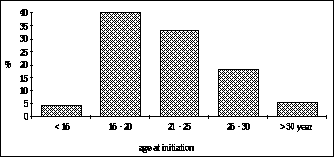
The mean age at which our respondents consumed their first cocaine was 22 years. Chitwood reports a mean age at initiation for his Miami subjects of 19.2 years, which is almost three years younger (Chitwood, 1985, p.114). A survey by Kandel et al. (1985, p.77) shows a mean age at initiation of 21 years for a New York sample of young adults. According to her, mean initiation age would rise if the sample included older users, which is the case in the Amsterdam sample. The Toronto community-based sample reported a mean age at initiation of 22.2 years.
Age of initiation is interesting, but we have to bear in mind that we cannot derive a 'typical initiation age' from such data. Many factors, like drug fashion, availability and price of cocaine and way of selecting respondents play a role, and these factors can vary considerably over time. This is illustrated by our failure to find cocaine users under twenty years during the winter of 1987, whereas 45% of our respondents indicated their age of initiation under twenty. One of the reasons for this apparently strange discrepancy could be that drug use fashions have changed for those under twenty.
Figure 2.2.a Age at initiation of cocaine use
(N=160;range: 13-40 yr; st. dev: 4.9 yrs)
2.3 Initiation company
Our respondents were asked to state with whom they used their first cocaine. We expected to find the usual high prevalence of friends (partners) at initiation. See Table 2.3.a.
Table 2.3.a Initiation of cocaine use use with...
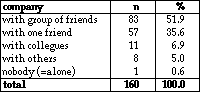
Very clearly the dominance of friends in initiation is demonstrated. Table 2.3.a also shows that colleagues play a minor role in initiation.
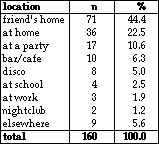
Table 2.4.a Location of first cocaine use
2.4 Location of first cocaine use
In June 1987 a disco in Amsterdam was closed because of cocaine use by clients. In Table 2.4.a we see, however, that disco's or bars in general played a minor role in initiation for our respondents. These data are consistent with those of paragraph 2.3, where the importance of friends was demonstrated for initiation.
2.5 First route of ingestion
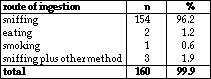
The choice of routes of ingestion we offered our respondents was larger than the four mentioned in Table 2.5.a. We showed a card which also mentioned: injecting, application to genitals, and free basing. Apparently the latter three methods are quite unpopular in this sample. Also after initiation occurrence of these methods is rare (see chapter 5).
Table 2.5.a Route of ingestion at initiation
2.6 Ways of obtaining first cocaine
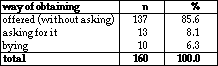
A minority of our respondents appears to have been actively seeking cocaine vs. a large majority simply 'finding' cocaine in their social environments.
Table 2.6.a Ways of obtaining first cocaine
2.7 Dosage at initiation
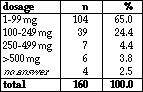
Average dose at initiation is 104 mg, a quantity of four lines. This quantity seems to be near the definition of experimental use by Siegel: "a maximum life time frequency of use of ten times (or a total intake of less than one gram)" (Siegel, 1985, 208). In another publication Siegel estimates the dose of an average recreational cocaine user to be 100 mg of street cocaine (Siegel, 1983, 53).
Table 2.7.a Dosage at initiation