
Uitermark, Justus, & Peter
Cohen (2006), Amphetamine users in Amsterdam. Patterns of use and modes
of self-regulation. Addiction Research & Theory January, Vol. 14, No. 2, pp. 159-188.
© Copyright 2004 Justus Uitermark & Peter
Cohen
Amphetamine users in Amsterdam
Patterns of use and modes of self-regulation[1]
Justus Uitermark & Peter Cohen
Abstract
After identifying some omissions in existing literature on research on amphetamine use, this paper sets forth to answer some questions with respect to (1) use patterns, (2) advantages and disadvantages of amphetamine use as experienced by users (3) the formal and informal modes of control that users employ to reduce or negate negative side-effects of amphetamine use, and (4) the role of context variables in fostering in facilitating these modes of control. The paper draws on a sample of 109 experienced and recent amphetamine users in Amsterdam and a follow-up sample of 67 respondents of the original 109. Through a discussion of use patterns over long periods of time, a longitudinal perspective is provided. Some policy implications are discussed.
1. Introduction
During the past ten years, a number of studies have argued that the dangers of amphetamine use should not be underestimated. These studies generally fall within one of two categories.
Studies in the first category have tried to study to what extent there is something like an 'amphetamine dependency syndrome' (e.g. Topp and Darke, 1997; Topp and Mattick, 1997a-b; Vincent et al., 1998). Using various measures of dependence or addiction, they have argued that amphetamine use may lead to severe forms of dependency in some or even most users. However, the problem with these studies is that it is questionable whether the results can be generalized to amphetamine users in toto, for they have only investigated amphetamine use in extreme-use samples - not community or population samples that include all users but mostly or only users who belong to a subculture in which heavy (intravenous) use is the norm[2]. Such groups do not form everywhere and where they do, not all or even most amphetamine users are part of extreme-use subcultures. It remains to be seen whether amphetamine users who do not belong to such groups also report high levels of use and associated problems. Moreover, these studies have not shed light upon the processes that lead respondents to report high scores on scales of dependency. They tend to assume a priori that the problems associated with amphetamine use can be directly attributed to the properties of the drug and its action on the user, only allowing for different impacts on individuals related to level of education or route of ingestion. In doing so, they tend to ignore a whole range of mediating factors. As we will argue below, the ability of drug users to regulate their own behavior, which is, at least partly, determined by the socio-cultural environment of which they are part, is one of the most important of these factors.
The second category of studies on amphetamine use explicitly focuses on special samples of groups of users, such as people who consult drug counselors or who make use of needle exchanges. It is an explicit goal of these studies to focus exclusively on a very select group of amphetamine users - again, typically the most extreme users - who constitute a potential target group for policies (e.g. Klee, 1997). While these studies may have the merit of mapping out some of the problems faced by a specific category of amphetamine users, their research design, questionnaires and sampling procedures guarantee that amphetamine use will be associated with all kinds of individual problems. We suggest that neither science nor policy is well served when research into the problems of such relatively small and exceptional groups is used to interpret global trends (such as increasing prevalence of amphetamine use in the population).
These two kinds of studies replicate a bias that is evident in research on other drugs, such as cocaine, heroin or cannabis: they focus on specific periods of heavy drug use of groups of people who often have been in the social margin for a long time already. However, these users are not representative of the population who use amphetamines in general, nor are their patterns of use at the moment when they report to researchers and social workers necessarily typical of their overall use pattern. Use patterns often look very different when viewed from a longitudinal perspective. It might well be that most amphetamine users, like users of other drugs, develop informal mechanisms of self-regulation that enable them to avoid escalation of their use and to mitigate the problems that might stem from use of amphetamine or from social responses to it (cf. Zinberg and Harding, 1982; Zinberg, 1984; Cohen, 1989; Waldorf et al., 1991; Cohen and Sas, 1995; Decorte, 2000). To see if this is indeed the case, we report on a sample of 109 experienced and recent amphetamine respondents in Amsterdam. In order to provide a long-term perspective, we conducted a follow-up survey in which 67 of these respondents of the first sample participated. We do not argue that our sample is fully representative of all different patterns of amphetamine use. On the contrary, we discuss use patterns of a fairly peculiar social group in a specific setting. We argue that our case study demonstrates that certain types of problematic behavior associated with prolonged amphetamine consumption tend to occur under specific conditions and are rare or absent when amphetamine users regulate their use. We look at mainstream citizens who use amphetamine rather than socially marginalized users, and we do not see the patterns of use and types of behavior normally associated, both in academic literature and public imagination, with amphetamine use.
The discussion on the self-regulation of drug use and career patterns, a neglected topic in the area of amphetamine research, is relevant to debates on drug policy. The approach one chooses to study drug use has indirect but important implications for drug policy. So far, both research and policy have been developed on the premise that each drug use can and often is a step towards addiction. Such an approach has no eye for various ways in which users manage their use in such a way as to avoid the extreme-use that is the prime focus of research and policy. By choosing an alternative analytical approach that foregrounds self-regulation of use, we highlight some new ways of conceptualizing both amphetamine use and policy options.
Most of the research on amphetamine use (and indeed other drug use) focuses on drug related problems and opportunities for policy interventions. We look at these issues from another angle. In essence our view on drug policy is liberal in the sense that we try to establish what kind of policy actions would be most appropriate if the goal is not simply to reduce the prevalence of drug use but instead to establish the conditions under which individuals are best able to manage their own drug use. Our approach is similar to the diverse group of practices known as harm reduction (see Caulkins and Reuter, 1997).
However, we feel that, by focusing on harm or even its reduction neglects the other side of the equation, namely that users can also derive benefits from drug use. The common harm reduction view that the object of policy should not be reducing use but rather reducing harm can incidentally reinforce some of the more traditional ideas about drug use. Rather than negating the idea that people use drugs because they are sick ('addicted') or lack moral standards, such harm reduction perspectives generally have been silent about the social origins and functions of drug use. In contrast, we direct attention to the reasons and motives users have for using drugs and on how their amphetamine use unfolds over time (cf. Shaw, 2002). In what follows, we thus (1) take into account the reasons drug users have for using drugs, (2) investigate what role mechanisms of self-regulation play in the mitigation of negative effects that can arise, and (3) consider policy options that might facilitate and support these mechanisms. This approach leads us to five specific questions:
- How did the use patterns of respondents develop over time: is their use escalating, stable, fluctuating or declining?
- To what extent do respondents experience negative side effects of amphetamine use?
- To what extent do respondents develop mechanisms of self-regulation and what is the nature of these mechanisms?
- To what extent do mechanisms of self-regulation contain the negative effects of amphetamine use, and to what extent do respondents experience lasting and serious problems that are associated with amphetamine use?
- How might public policy mitigate the negative effects associated with some patterns of amphetamine use and how might policy facilitate efforts of users to maximize the advantages they find in amphetamine use while minimizing the disadvantages?
In the second section below, we discuss the main characteristics of our sample and show that it largely consists of a new generation of amphetamine users. In the third section, we describe the user careers of the respondents by showing how their level of use varies over time. In the fourth section, we discuss the problems respondents reported as associated with amphetamine use. We show that problems considered typical of amphetamine use do not occur in all or even most of the respondents. We focus in the fifth section on the modes of self-regulation that help the respondents to curtail disadvantages and to optimize advantages. In the sixth section, we describe the small group of respondents who report relatively high levels of use and signs of losing control over their amphetamine use, and we try to answer the question whether the problems of these respondents are permanent or temporary. Finally, we interpret the presented data and we distill some policy implications.
2. The sample
Since mechanisms of self-regulation can only be examined in experienced users, we decided to include in our sample only amphetamine users who had used the drug on at least fifteen occasions. Furthermore, we wanted to interview only recent users on the assumption that they would tend to have the most accurate recall about their drug use and related behavior. This second consideration led to a second inclusion criterion: we included in our study only respondents who had used amphetamine at least once during the two years prior to the interview. We were, of course, relying on self reports. This matters not only because respondents can have distorted memories or willfully twist the truth but also because respondents themselves may not have been able assess what kind of substance they were using[3].
For logistical reasons we decided to include only respondents from Amsterdam. During the fieldwork for the National Survey on Drug Use (Abraham et al., 1999) all 3710 respondents in Amsterdam were asked if they had ever used amphetamine. Those respondents who answered affirmatively were asked if they met the entry criteria for our study. If they did, they were asked if they were willing to participate in our study on amphetamine use.
However, this recruitment strategy yielded only seven respondents, reflecting both the low prevalence of experienced amphetamine use in the Amsterdam population and reluctance to participate. We therefore decided to use a snowball sampling strategy to recruit more respondents (see Biernacki and Waldorf, 1981; Cohen, 1989; Cohen and Sas, 1992, 1995) The seven respondents recruited during the National Survey as well as amphetamine users known to the research staff and the field workers were asked to list people in their personal environment who met the inclusion criteria. Further, respondents recruited in this way were also asked to put us into contact with people who met the criteria. A total of 109 respondents were recruited. All were interviewed face-to-face, with interviews taking between 1.5 and 3.5 hours.
Since the respondents were recruited through social networks, it is likely that our sample is biased. We lack necessary data to accurately assess the extent or direction of bias, but we can give an approximate judgment by comparing our sample to amphetamine users in >Amsterdam> taken from a random sample of >Amsterdam> inhabitants of 12 years and over (see Abraham et al., 1998, 2001). To facilitate this comparison, we put together in one file the respondents who reported lifetime prevalence of amphetamine use in both national surveys (201 in 1997, 234 in 2001). The respondents in this file were weighed according to sex and age. We distinguished four (overlapping) sub samples, labeled Populations 1-4. 'Population 1' consists of respondents who reported having used amphetamine at least once during their lifetime. 'Population 2' consists of respondents who had used amphetamine during the year prior to the interview. 'Population 3' consists of respondents who had used amphetamine on more than 25 occasions during their lifetime. 'Population 4' consists of respondents who had used amphetamine on more than 25 occasions and at least once during the year prior to interview.
| Age | Sample |
Pop. 1 |
Pop. 2 |
Pop. 3 |
Pop. 4 |
|||||
|---|---|---|---|---|---|---|---|---|---|---|
n |
% |
n |
% |
n |
% |
n |
% |
n |
% |
|
| 14 - 17 | 15 | 13,8 | 9 | 1 | 6 | 3,7 | 2 | 0,6 | 2 | 2,3 |
| 18 - 25 | 68 | 62,4 | 69 | 17,2 | 25 | 37,2 | 19 | 17,8 | 9 | 32,8 |
| 26 - 35 | 20 | 18,3 | 126 | 29,9 | 28 | 42,6 | 25 | 22,1 | 10 | 34,8 |
| 36 - 45 | 4 | 3,7 | 135 | 30,5 | 8 | 12,1 | 36 | 30,9 | 6 | 20,1 |
| 46 - 55 | 2 | 1,8 | 64 | 14,3 | 3 | 4,4 | 26 | 19,9 | 3 | 10,1 |
| Older than 56 | 32 | 7,2 | 12 | 8,8 | ||||||
| Total | 109 | 100 | 435 | 100,1 | 70 | 100 | 120 | 100 | 30 | 100,1 |
| Average | 23,0 | 37,2 | 28,1 | 38,3 | 30,5 | |||||
| * In tables 1-6, percentages to not correspond to absolute figures because the percentages refer to weighed respondents whilst the absolute figures refer to the absolute number of respondents in the respective categories | ||||||||||
| Average net income per month |
Sample |
Pop. 1 |
Pop. 2 |
Pop. 3 |
Pop. 4 |
|||||
|---|---|---|---|---|---|---|---|---|---|---|
n |
% |
n |
% |
n |
% |
n |
% |
n |
% |
|
| Less than ƒ 750 | 31 | 28,4 | 19 | 4,3 | 6 | 6 | 7 | 5,1 | 3 | 7,5 |
| ƒ 750 - ƒ 1,250 | 30 | 27,5 | 26 | 5,8 | 4 | 5,5 | 10 | 8 | 2 | 6,6 |
| ƒ 1,250 - ƒ 1,500 | 9 | 8,3 | 52 | 11,7 | 12 | 19 | 21 | 16,7 | 6 | 19,7 |
| ƒ 1,500 - ƒ 2,000 | 15 | 13,8 | 59 | 13,7 | 6 | 9,6 | 17 | 14,6 | 3 | 10,5 |
| ƒ 2,000 - ƒ 2,500 | 8 | 7,3 | 66 | 14,5 | 11 | 17,9 | 22 | 18,6 | 6 | 23,6 |
| ƒ 2,500 - ƒ 3,000 | 7 | 6,4 | 51 | 12,7 | 9 | 12,9 | 11 | 9,4 | 4 | 12,5 |
| ƒ 3,000 - ƒ 4,000 | 3 | 2,8 | 69 | 16,1 | 7 | 11,3 | 16 | 13,9 | 2 | 7,3 |
| ƒ 4,000 - ƒ 5,000 | 2 | 1,8 | 24 | 5,3 | 4 | 3,6 | ||||
| More than f 5.000 | 2 | 1,8 | 21 | 5,4 | 3 | 2,6 | ||||
| Don't know / no answer | 2 | 1,8 | 48 | 10,5 | 15 | 17,9 | 9 | 7,6 | 4 | 12,3 |
| Total | 109 | 100 | 435 | 100 | 70 | 100 | 120 | 100 | 30 | 100 |
| Educational level | Sample |
Pop. 1 |
Pop. 2 |
Pop. 3 |
Pop. 4 |
|||||
|---|---|---|---|---|---|---|---|---|---|---|
n |
% |
n |
% |
n |
% |
n |
% |
n |
% |
|
| Elementary school | 9 | 8,3 | 23 | 4,9 | 9 | 10,9 | 11 | 7,8 | 4 | 8,4 |
| Low level vocational school | 1 | 0,9 | 34 | 7,7 | 6 | 6,1 | 9 | 7,5 | 1 | 3,1 |
| Medium level high school, years 1-3 | 8 | 7,3 | 23 | 4,8 | 6 | 9 | 12 | 8,7 | 5 | 15,9 |
| Medium level high school, years 4 | 8 | 7,3 | 12 | 2,7 | 4 | 5,1 | 4 | 3,8 | 1 | 3,2 |
| High level high school, years 1-3 | 10 | 9,2 | 20 | 4,2 | 2 | 2,3 | 5 | 3,9 | 1 | 3,9 |
| High level high school, years 4 and higher | 53 | 48,6 | 96 | 23 | 19 | 28,6 | 30 | 26,1 | 9 | 31 |
| Medium level vocational school | 6 | 5,5 | 53 | 13,1 | 6 | 9,2 | 12 | 10,8 | 2 | 7,8 |
| High level vocational school | 11 | 10,1 | 93 | 21 | 10 | 16,6 | 24 | 20,7 | 5 | 19,7 |
| University, phase 1 (Masters) | 3 | 2,8 | 62 | 14,4 | 7 | 11 | 9 | 7,6 | 1 | 4,6 |
| University, phase 2 (PhD) | - | - | 7 | 1,6 | - | - | 1 | 0,8 | - | - |
| University, post-doctoral | - | - | 8 | 1,6 | 1 | 1,1 | 2 | 1,5 | 1 | 2,4 |
| No answer | - | - | 4 | 0,9 | - | - | 1 | 0,8 | - | - |
| Total | 109 | 100 | 435 | 100 | 70 | 100 | 120 | 100 | 30 | 100 |
| Educational level | Sample |
Pop. 1 |
Pop. 2 |
Pop. 3 |
Pop. 4 |
|||||
|---|---|---|---|---|---|---|---|---|---|---|
n |
% |
n |
% |
n |
% |
n |
% |
n |
% |
|
| Elementary school | - | - | - | - | - | - | - | - | - | - |
| Low level vocational school | 1 | 1,5 | 2 | 0,9 | 1 | 1,1 | 2 | 3,7 | 1 | 3,4 |
| Medium level high school, years 1-3 | 2 | 3 | - | - | - | - | - | |||
| Medium level high school, years 4 | 3 | 4,5 | 2 | 0,7 | 2 | 2,5 | 1 | 1,4 | 1 | 4,1 |
| High level high school, years 1-3 | - | 1 | 0,4 | - | 2,2 | - | - | |||
| High level high school, years 4 and higher | 15 | 22,7 | 4 | 2,9 | 1 | 31,2 | 1 | 2,4 | 1 | 6,9 |
| Medium level vocational school | 6 | 9,1 | 14 | 11,7 | 10 | 21,0 | 5 | 18,9 | 3 | 32,5 |
| High level vocational school | 14 | 21,2 | 29 | 28,1 | 6 | 21,7 | 4 | 17,6 | 2 | 25,9 |
| University, phase 1 (Masters) | 23 | 34,8 | 14 | 15,3 | 5 | 3,4 | 3 | 13,1 | 1 | 14,2 |
| University, phase 2 (PhD) | 1 | 1,5 | 1 | 0,9 | 1 | - | - | |||
| University, post-doctoral | - | 1 | 1,3 | - | 16,8 | - | - | |||
| Other | 1 | 1,5 | 40 | 37,9 | 4 | 11 | 43,0 | 1 | 13,2 | |
| Total | 66 | 100 | 108 | 100 | 30 | 100 | 27 | 100 | 10 | 100 |
| Not applicable / no answer | 43 | 39,4 | 327 | 75,2 | 40 | 57,1 | 93 | 77,5 | 20 | 66,7 |
| Type of drugs | Sample ( n =109) |
Pop. 1 ( n =435) |
Pop. 2 ( n =70) |
Pop. 3 ( n =120) |
Pop. 4 ( n =30) |
|||||||||
|---|---|---|---|---|---|---|---|---|---|---|---|---|---|---|
| Alcohol | 100 | 99,8 | 98,9 | 100 | 100 | |||||||||
| Cannabis | 98,2 | 91,5 | 98 | 91,3 | 100 | |||||||||
| Cocaine | 89,9 | 71,1 | 84,8 | 83,5 | 97,9 | |||||||||
| Heroin | 24,8 | 16,8 | 10,2 | 23,2 | 15,1 | |||||||||
| Hallucinogens | 81,7 | 48,4 | 47,2 | 68,5 | 74,2 | |||||||||
| Mushrooms | 91,7 | 49,5 | 69,6 | 56,4 | 79,7 | |||||||||
| Tabacco | 97,2 | 93 | 95,6 | 94,2 | 96,8 | |||||||||
| Ecstacy | 98,2 | 55,7 | 86,6 | 54,1 | 90,8 | |||||||||
| Sex | Sample |
Pop.1 |
Pop.2 |
Pop.3 |
Pop.4 |
|||||
|---|---|---|---|---|---|---|---|---|---|---|
n |
% |
n |
% |
n |
% |
n |
% |
n |
% |
|
| Male | 88 | 80.7 | 256 | 64.7 | 46 | 68.7 | 75 | 67.7 | 21 | 72.2 |
| Female | 21 | 19.3 | 179 | 35.3 | 24 | 31.3 | 45 | 32.3 | 9 | 27.8 |
| Total | 109 | 100 | 435 | 100 | 70 | 100 | 120 | 100 | 30 | 100 |
As Table 1 shows, our respondents are considerably younger than respondents in the comparison groups. The age group 18-25 especially is over-represented. Apparently, older amphetamine users are almost totally absent from our sample. As might be expected, our (relatively young) respondents generally have relatively low incomes compared to the reference groups whilst they are also more often enrolled in education (tables 2 and 4). Taking into account the fact that many of the respondents are relatively young and often still enrolled in school (table 3), their level of education is relatively high. Table 5, on other drug use, shows that the respondents have relatively high levels of prevalence of use of all types of drugs. Lifetime prevalence of hallucinogens and mushrooms use is especially high compared to the comparison groups, which in part reflects the higher prevalence for these drugs amongst younger people in general. Table 6 shows that men are slightly over-represented in our sample.
The data in Tables 1-6 indicate that our sample is not representative of the Amsterdam population of experienced and recent amphetamine users as a whole. Although some older respondents are included in our sample, most seem to belong to a new generation of amphetamine users. Like the younger generation as a whole, respondents in our sample are generally well educated and have relatively good career prospects that have for the most part not yet materialized into high incomes. Combined with findings from the study (see below), the data in Tables 1-6 indicate that the amphetamine users in our sample are involved in the emergence of new music and youth subcultures during the late 1980s and early 1990s (Van der Wal and Bleeker, 1997; Van de Wijngaart et al., 1999). The cultures emerged in the late 1980s/early 1990s but have not disappeared since then. For example, for more than 90 percent of the respondents, amphetamine use is related to party settings (see Table 10 below; cf. Abraham, 1999). However, our sample not only includes respondents from youth/party subcultures and, although 'parties' are an important occasion for the use of amphetamine, their use is not restricted to these settings. We describe the situations in which the respondents use amphetamine in more detail below. Although our sample also includes respondents who have used amphetamine for a relatively long period of time and/or whose amphetamine use is not (only) associated with expressions of youth culture, we feel our findings are at least indicative of use patterns of a new generation of amphetamine users who got acquainted with the drug as a consequence of the rise of certain youth subcultures of the late 1980s and 1990s.
For our follow-up survey, we tried to contact all respondents about two years after their first interview. The first interviews were conducted in 1998-1999, the second interviews in 2000-2001. We sent letters to the respondents, announcing that we would try to contact them by telephone for a brief follow-up interview. Many respondents had moved and/or had changed their (mobile) telephone number. Still others were away for a long time, for example to travel after their graduation. The greatest difficulty was that many of the respondents were rarely at home. This reduced the chance that they could be contacted, or in case they used a mobile phone, had the chance to speak freely. Because of these difficulties, we decided to try and contact those respondents during regular intervals who had not yet been interviewed for a period of circa two years. None of the respondents contacted refused to take part in the second interview[4]. We managed to locate and interview 68 of our former respondents, 62.4 percent of the original sample. Even though they were given the opportunity to participate in a face-to-face interview, all respondents agreed to do the second interview over the telephone. Interviews took between 10 and 15 minutes. Sixty-one respondents (91.0 percent) were interviewed between two or three years after the first interview. Two respondents were interviewed respectively 21 and 22 months after the first interview and four respondents were interviewed between three and four years after the first interview[5]. The follow-up sample did not differ significantly from the rest of the sample with respect to age (average: 22.8 for follow-up respondents [n=68], 23.1 for respondents not included in the follow-up [41]) Highest completed level of education and income per month were somewhat lower among the respondents in the follow-up sample but again the differences were not statistically significant. Although it should be kept in mind that our follow-up respondents have a slightly lower socio-economic status than the rest of the sample, we feel that the results in the follow-up research are to a large extent representative for the sample as a whole.
Before we continue, it is appropriate to say a few words about the geographical context in which the respondents use amphetamine. Although lifetime prevalence of amphetamine in Amsterdam is about three times as high as the Dutch average (Abraham et al., 1999, 2002), still only a very small proportion of the population has ever used amphetamine. Amphetamine use is not associated with a stigma, largely due to the fact that the general public is not familiar with the drug.
3. Patterns of use
Levels of use
During the first interview, we asked respondents to estimate how many grams of amphetamine or how many pills containing amphetamine they had used during four periods of use: the first period of regular use, the period of heaviest use, twelve months prior to the interview and three months prior to the interview[6]. All these periods can of course overlap, but these data nevertheless allow us to calibrate how the amphetamine use of the respondents develops over time. Since we do not have sufficient data to establish the composition of the pills used by the respondents, we did not try to convert pills into grams or vice versa. We distinguished between three levels of use: 'low' (0-2.5 grams per month), 'medium' (2.5-10 grams per month) and 'high' (> 10 grams per month).
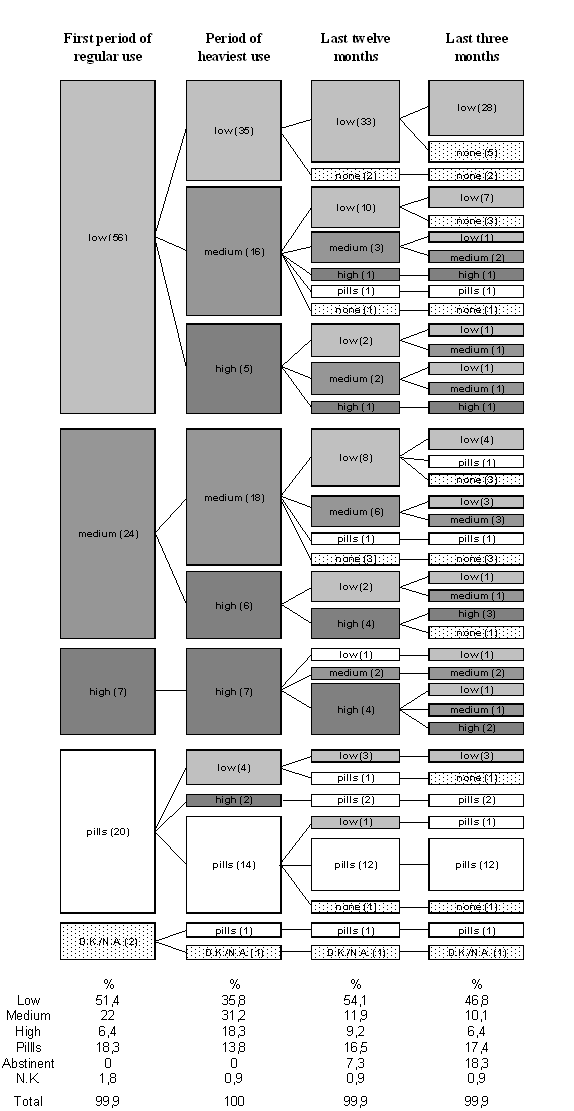 |
Figure 1 follows the respondents through time, showing how their use developed from the first period of regular use onwards[7]. The size of Figure 1 is partly related to the fact that individual user careers vary considerably. Respondents who start using low quantities and who do not progress to medium or high level use are an exception to this rule. They constitute 50.0 percent of the respondents who reported a low level of use during the period of initial use and 25.7 percent of the sample as a whole. Although their numbers are low, some respondents report to have used on a high or medium level for a prolonged period of time. After the initial period of amphetamine use, 16 out of 107 respondents consistently used on a medium or high level.
Frequency of use
Since we thought it irresponsible to recompute the number of consumed pills into grams or vice versa, we used another way to compare all the respondents with each other. Figure 2 shows the frequency of use of during a normal week. In the first period of use, about half of the respondents (51 or 46.8 percent) indicate that they used amphetamine at least once a month but less than once a week. During the period of heaviest use, 41 respondents (37.6 percent) used amphetamine once a week. More than half of the respondents, 56 or 51.4 percent indicated that their frequency of use increased considerably when they entered their period of heaviest use. Three respondents (2.8 percent) report 'daily' use in all three periods. Another three respondents report 'daily' use after initial use at lower frequency. More than half of the respondents (60 or 55.0 percent) indicate that they use amphetamine more than once a week during their period of heaviest use. In contrast, a large majority of the respondents used amphetamine less than once a week during all the other periods. Frequent use is common in the period of heaviest use, but rare in other periods.
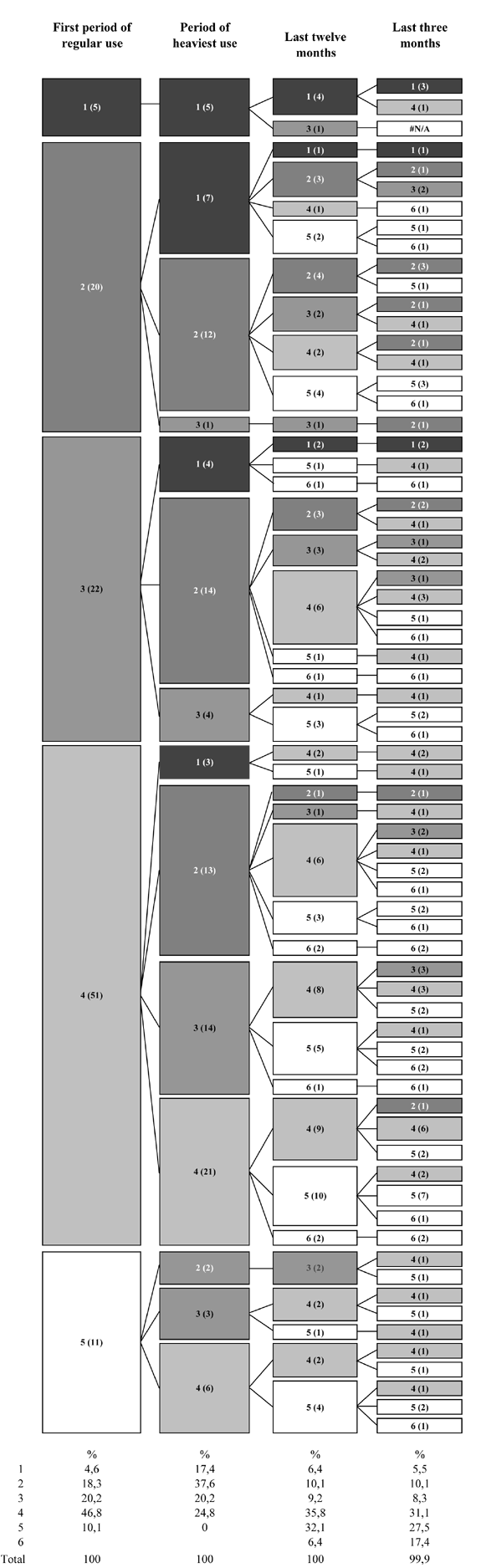 |
1 daily |
Ideal-types of use
Both methods of mapping the evolution of levels of amphetamine use described above have the disadvantage that several periods of use may overlap, which could blur increases or decreases in use over shorter periods of time. Therefore we presented the respondents in both surveys with six ideal-typical use patterns that we adapted from Morningstar and Chitwood (1983) (Table 7). We asked respondents to indicate which type best represented their pattern of use during the twelve months prior to interview (Figure 3). We also presented these patterns to respondents who had quit using amphetamine and asked them if they could pick the figure that best represented their pattern of use during the last twelve months of their amphetamine-using career.
During the first interview, 45 respondents (41.3 percent) said that pattern 4 (up-top-down) best represented their pattern of use: their use had gradually increased over time, but after reaching a peak it had gradually diminished. 32 respondents (29.4 percent) chose pattern 6, 15 respondents (13.8 percent) chose pattern 3, ten respondents chose pattern 2, five respondents chose pattern 1 (4.6 percent) and two respondents opted for pattern 5 (1.8 percent). Since the second interview was carried out over the telephone, we did not have the opportunity to show the respondents the graphic illustrations but we did ask them to pick from the six descriptions the one that best represented their use pattern. Of the follow-up respondents 41.1 percent choose for the same pattern as in the first interview but the over-all results are very similar to those to those during the first investigation.
Pattern 4 (up-top-down) was even more common during the second interview: 29 respondents (26.6 percent) said this pattern represented their career best. The least common pattern in interview 1, pattern 5, was not chosen by any of the respondents. The only important difference is that now pattern 1 - level of use has gradually diminished over time - ranks second, with 17 respondents (25.0 percent). Two respondents (2.9 percent) chose pattern 2[8].
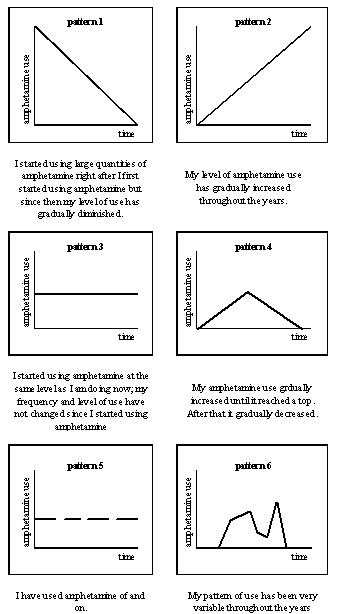 |
Sources: after Morningstar and Chitwood, 1983 |
Levels of use: data from the follow-up survey
In the follow-up survey we again asked the respondents about their use during the last twelve and three months prior to the interview. Although the time interval between the interviews is not identical for all respondents, we can get a general picture of the user careers of the respondents by showing how their level of use developed over the four periods (Figure 4). This comparison gives us a more complete and dynamic picture of user careers over a long period of time (at least three years and in most cases more than five years). This is especially important when it is realized that our sample largely consists of a new generation of amphetamine users who have only recently initiated use (on average 4.4 years before the first interview). The period of heaviest use lasted on average 14 months compared to 19 months for a sample of experienced cocaine users and 39 months for a sample of experienced cannabis users (Cohen and Sas 1995, 1998).
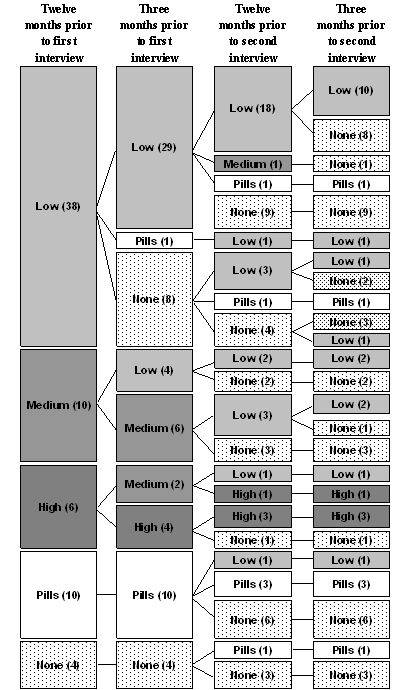 |
Table 7 shows that continued low-level use (0-2.5 grams per month), is a common career pattern even when we look at a longer period of time. More noteworthy is the rather rapid increase in the number of respondents who report having been abstinent. During the last three months prior to the follow up interview, more than half the respondents (38 or 55.9 percent) reported using no amphetamine at all. None of the respondents who report low- or medium-level use or who report their level of use in quantities of pills during the first two periods, reported high-level use during the last two periods. Only one respondent progressed to medium level use (2,5-10 grams per month) in the period twelve months before the second interview, but he was abstinent during the next period. From a longer-term perspective, decreasing levels of use and/or abstinence are the norm for the large majority of the respondents.
Respondents with higher levels of use during the first two periods tend to report higher levels of use during the latter two periods. This was particularly so for four respondents who reported high-level use (>10 grams per month) in the twelve months prior to the first interview. Three of them continued to use amphetamine at high levels while one reported high use levels during three periods with the exception of three months prior to the first interview.
| Pattern during first interview | Pattern during second interview |
|||||
|---|---|---|---|---|---|---|
1 |
2 |
3 |
4 |
6 |
Total |
|
| 1 | 1 | 2 | 3 | |||
| 2 | 2 | 2 | 2 | 6 | ||
| 3 | 1 | 1 | 2 | 3 | 1 | 8 |
| 4 | 9 | 1 | 1 | 18 | 3 | 32 |
| 6 | 5 | 1 | 5 | 8 | 19 | |
| Total | 17 | 2 | 6 | 28 | 12 | 68 |
4. Problems associated with amphetamine use
We have major difficulties with the way in which dependence or addiction is usually measured. It seems to us that the criteria used by DSM or other methods to measure dependency prematurely ascribe problems associated with drug use to drug use itself. We think that mediating factors, such as the societal response to drug use or the characteristics of the social context in which drugs are used, are critically important influences on the extent to which users experience problems (cf. Cohen, 2000). But if we put aside for the moment the question of the origins of problems associated with drugs - are they socially constructed or intrinsic to the properties of a drug? - indicators of 'dependency' can help show to what extent respondents experience problems associated with amphetamine use. We used two such measures: DSM and a much more elaborated 'loss of control' scale (Cohen and Sas, 1992)
DSM
Whilst DSM-IV (APA, 1994) uses a 12-month period, we also asked the respondents about the prevalence of DSM items of 'dependency' during the entire user career to diminish artificial differences between respondents and to assess whether respondents would receive higher scores over a longer period of time.
In the questionnaire we included eight questions based on the DSM-IV criteria, which led to the following results:
- During their entire user career 68 percent of the respondents (74) had ever found themselves using larger amounts of amphetamine than they intended to, or used it for longer periods than they intended to, for more than a week. For the period twelve months before the interview the figure is 34 percent (37 respondents).
- During their entire user career 39 percent of the respondents (42) had ever felt a persistent desire to cut down on amphetamine use or tried unsuccessfully to cut down, for more than a week. For the period twelve months before the interview the figure is 23 percent (25 respondents).
- During their entire user career 38 percent of the respondents (41) had ever given up or reduced social, recreational or work activities because of their amphetamine use for more than a week. For the period twelve months before the interview the figure is 21 percent (23 respondents).
- During their entire user career 25 percent of the respondents (27) had ever kept using amphetamine for more than a week when they had a recurring physical or psychological problem that was either caused or worsened by amphetamine use. For the period twelve months before the interview the figure is 15 percent (16 respondents).
- During their entire user career 35 percent of the respondents (38) had ever failed to meet obligations at work or school or home for more than a week because of his or her amphetamine use. For the period twelve months before the interview the figure is 17 percent (18 respondents).
- During their entire user career 24 percent of the respondents (26) had ever kept using amphetamine for more than a week when having recurring social or interpersonal problems that were caused or worsened by amphetamine use. For the period twelve months before the interview the figure is 11 percent (12 respondents).
- During their entire user career 66 percent of the respondents (72) needed to use larger doses of amphetamine in order to reach the same effect. For the period twelve months before the interview the figure is 34 percent (37 respondents).
- During their entire user career 27 percent of the respondents (29) had physical complaints when they quit amphetamine that negatively affect their functioning in daily life. For the period twelve months before the interview the figure is 17 percent (18 respondents).
Table 8 shows that 57 percent of the respondents report three or more positive scores in DSM-IV criteria during entire user career. This figure drops to 27 percent for the period of twelve months prior to the interview. The number of reported DSM-IV items during entire user career strongly correlates with the amount of use during top period (Spearman r=0,586, p=0.000)[9]. There is an even stronger correlation between the number of reported DSM-IV items during the last twelve months and the amount of amphetamine use (in grams) during the last twelve months prior to the interview (Spearman r=0,681, p=0.000)[10].
| Entire user career | Last twelve months | |||||
|---|---|---|---|---|---|---|
| Number of criteria | n |
% |
Number of criteria | n |
% |
|
| 0 | 10 | 9,2 | 0 | 45 | 41,3 | |
| 1 | 19 | 17,4 | 1 | 24 | 22,0 | |
| 2 | 18 | 16,5 | 2 | 11 | 10,1 | |
| 3 | 16 | 14,7 | 3 | 7 | 6,4 | |
| 4 | 15 | 13,8 | 4 | 6 | 5,5 | |
| 5 | 14 | 12,8 | 5 | 8 | 7,3 | |
| 6 | 7 | 6,4 | 6 | 3 | 2,8 | |
| 7 | 6 | 5,5 | 7 | 3 | 2,8 | |
| 8 | 4 | 3,7 | 8 | 2 | 1,8 | |
| Total | 109 | 100 | Total | 109 | 100 | |
| Average 3.2 | Average 1.7 | |||||
We may conclude, on the one hand, that many respondents experienced at least some problems associated with amphetamine use and that these problems increased with the amount of amphetamine used. On the other hand, since DSM-IV scores are considerably lower during the last twelve months than during the entire user career, it seems that these problems do not increase over time. Since we wanted to keep the second questionnaire as short as possible, we did not address DSM-IV items in the follow-up survey. However, since most respondents in the second survey had not intensified their use after the first interview, we may assume that the respondents would exhibit at least identical scores of DSM-IV items.
These results show a marked contrast with respect to results obtained by other studies. For example, Topp and Darke (1997, p. 116) find that, for all 'symptoms of dependency' (as derived from DSM-III-R and DSM-IV), more than two thirds (66 percent to 98 percent) of their 331 respondents scored positively and conclude that, on the basis of DSM-IV criteria, 97 percent of the sample would be considered 'dependent'. We already gave some possible reasons for these important differences in the introduction: the sample of Topp and Dark consisted of individuals who used at least once a month and who frequently injected amphetamine. Only one eighth of their sample was in employment while another 20 percent were enrolled as students. Overall, their respondents reported many deviant activities, which is probably not related to amphetamine use per se but to their (weak) socio-economic position and their inclusion in subgroups in which heavy drug use is the norm. In the Amsterdam sample we present here these aspects of deviance were not present.
Loss of control scale
The second technique we use to measure problems associated with amphetamine use makes use of a loss of control scale (see Sas and Cohen, 1992). The purpose of this scale is not so much to measure the experience of problems of individual users but to rank respondents according to the extent to which they show signs of 'losing control'. Section 6 describes how use patterns of more 'problematic' users have changed several years after the first interview. For now, the loss of control scale can be said to give a more accurate impression than DSM of the extent to which the respondents experience problems associated with amphetamine use.
According to Waldorf et al. (1991) loss of control can take one of two forms. On the one hand, users could exhibit increasing levels of use and experience dependency. On the other hand, amphetamine use may adversely affect the user's position in society, thus affecting both professional and social relationships. The loss of control scale used here takes both aspects into account. Respondents are assigned scores on each aspect. The maximum score is 65 for each aspect and 130 for the two aspects combined. To measure loss of control on the individual level we assigned points according to the scores of respondents on DSM-IV items (maximum 15 points), the development of use over time (15), whether respondents had ever unsuccessfully tried to quit (4), whether respondents had ever craved amphetamine (1), whether craving had been accompanied by physical and/or mental problems (1 point each), whether respondents felt they had their use 'under control' (4), and whether respondents had ever considered seeking professional treatment (4). To measure the social problems related to drug use, we assigned points if respondents had ever undertaken 'deviant' activities, such as dealing amphetamine or committing burglary (maximum of 2 points for each activity, 26 points in total) and if amphetamine had adversely affected their work or social relationships (39 points). The loss of control scale has many more items, is far more differentiated that DSM-IV, and less psychologically orientated. However, we never correlated the outcomes of the loss of control scale with other indicators of 'dependence' or 'severity of addiction' because of the large conceptual differences between these indicators.
None of the respondents came close to the maximum score of 130 whilst many came close to 0. The average score is 17.0, the median score is 15.5, and the standard deviation is 12.6. We decided somewhat arbitrarily to highlight the use patterns of respondents who had a score of 20 or more (see section 6). Of the 36 respondents who had such a score, 19 were interviewed in the follow-up survey.
5. Modes of self-regulation
This section examines the nature of the mechanisms of self-regulation developed by the respondents. We consider implicit and explicit modes of self-regulation in turn. Finally, we discuss the wider social networks in which the respondents are embedded and which can be considered to facilitate implicit as well as explicit modes of self-regulation.
The social context in which drugs are used and in which drug users have been raised is of crucial importance for understanding the functions and limits of modes of self-regulation (cf. Zinberg, 1984, pp. 15-18). These modes of self-regulation can essentially be described as socially learned behaviors that enable an individual to cope with certain situations:
The social acquisition of informal control mechanisms begins in early childhood. . They originate largely through unknown processes in the social interactions between users. They develop gradually in ways that tally with changing socio-cultural and subcultural conditions (Decorte, 2000, pp. 39-40)
We may add that the interactions between users and non-users are important as well. For example, when users feel that their social environment disapproves of their use, they may limit amphetamine use to situations where they are alone or in company of other users. Similarly, the presence of a sizeable group of heavy and/or marginalized users may allow the development of norms, sanctions and rules that are specific to that heavy-use subculture. Subcultural institutions may serve to increase the distance between mainstream society and drug users (cf. Carstairs, 2002). In Amsterdam, there does not seem to be such a visible group of marginalized and stigmatized 'speed freaks' where users of amphetamine could go to be accepted by their fellow-users but rejected by others. In our view this is one of the context variables that make it unlikely that amphetamine users will drift into (deeper) deviance.
As with other types of learning, some individuals may be better in picking up these rules and behaviors than others. In general, however, the extent to which users develop modes of self-regulation will vary according to the resources available in their social environments, i.e. the behaviors that are common in their environments and that can serve as examples for their own behavior. Therefore, the extent to which individuals are able to regulate their own amphetamine use and blend it into a vast series of other mainstream social interactions is not purely an individual quality; it is a quality of a certain cultural environment that can manifest itself more or less in individuals.
Implicit modes of self-regulation
Implicit modes of self-regulation are behaviors that serve to mitigate harmful effects of amphetamine use but that are not necessarily recognized as such by the drug user. Users may decide to use amphetamine only in particular situations and under certain circumstances. The decision to use amphetamine only in particular situations can be seen as an attempt to embed amphetamine use within an appropriate setting. Although such decisions do not necessarily entail conscious abstinence under other circumstances, they nevertheless do have a mitigating effect with regard to the potential harms associated with amphetamine use since the users (subconsciously) tailor the use of amphetamine to circumstances under which the balance between positive and negative effects of use is optimal.
We asked the respondents to name up to five of the most common situations in which they had used amphetamine during their entire user career. As Table 10 shows, 294 situations were mentioned altogether. It should be noted that Table 10 presents aggregate categories. In many cases, answers were far more specific than the table suggests. For example, the category 'parties' is also made up of 'techno parties'. If respondents indicated that they 'always' use amphetamine at a techno party, our aggregation might give the false impressions that they 'always' use at any kind of party. Similar comments could be made about the other categories. Nevertheless the table shows clearly that most respondents consider parties as appropriate occasions for use. Other popular occasions are related to social activity, such as 'going out' (44 respondents or 40.4 percent) or 'with friends' (39 respondents or 35.8 percent). These three situations related with 'going out and socializing' account for more than half of the situations mentioned by the respondents. Other situations for amphetamine use are clearly more idiosyncratic, although a large proportion is related to enhancement of performance (e.g. 'school', 'to stay awake', 'when I must be active'). Day-to-day activities are mentioned, but not often. Only a few respondents indicate that they use often or always 'at work', 'at home' or 'to stay awake'.
In contrast, many respondents indicate that they do not use amphetamine when they have to work or study (Table 11). Meetings with parents or other relatives are also considered as occasions unfit for amphetamine use by a number of respondents. Combined, Tables 9 and 10 show that most of the respondents restrict their amphetamine use to specific occasions; they choose occasions where the benefits of amphetamine use are maximized and avoid use when the chances of undesirable consequences are considered too high.
Another way for enquiring into implicit modes of self-regulation is to ask respondents if they have ever dissuaded others to use amphetamine. Their answers not only show how groups of amphetamine users exercise social control on each other's amphetamine use but also indicate why respondents do consider themselves fit for amphetamine use. Table 12 shows that respondents have dissuaded other people to use amphetamine far more often than they have persuaded others to do so. Reasons for dissuading amphetamine use in others mostly relate to negative effects which are believed to be intrinsic to amphetamine (e.g., 'it is bad for your health' or 'it is addicting'). Another important reason for dissuading use in others is that the person in question is not judged 'fit' for amphetamine use, for example, because he or she is considered to be 'too young', or 'unstable'. However, a large proportion of the reasons mentioned for dissuading amphetamine use in others was highly idiosyncratic, e.g., 'this person was already quite neurotic' or 'because this person was treated several times in a mental hospital'. This again shows that most respondents feel that there is a time and place for amphetamine and that not everybody will be able to develop the kind of self-regulation necessary to create a positive balance between the disadvantages and advantages of amphetamine use. Reasons for persuading someone to use amphetamine were mostly related to 'sharing the experience' and to 'draw someone into the group', showing that a collective positive experience is an important element of amphetamine use for many of the respondents.
Explicit modes of self-regulation
By explicit modes of self-regulation, we mean rules and behaviors that were explicitly mentioned by the respondents as means of regulating (the harmful effects of) amphetamine use. Many of the respondents report to have formulated such rules for themselves. Of all respondents 83 (76 percent) indicate that they use personal rules when using amphetamine. We asked respondents to state the rules they used when using amphetamine. All together, 182 rules were mentioned. The most often mentioned rules are exclusionary ones: not too much, not more that given dosage, only during weekends (Table 9).
Another way to ask for rules and norms around the use of amphetamine is to ask what kind of advice the respondents, as experienced amphetamine users, would give to novice users. We may assume that they would try to teach these novice users the same modes of self-regulation they had picked up during their own user career and that helped them regulate the effects of amphetamine according to their own preferences. We asked respondents to give advice on five aspects of amphetamine use: dose, route of ingestion, situations for amphetamine use, combinations with other drugs, and ways of dealing with disadvantages of amphetamine use (table 13). With respect to dose and route of ingestion, the advice given by the respondents to hypothetical novice users seems to reflect their own preferences. As they themselves generally use low doses of amphetamine, it is not surprising that most respondents think that novice users should also use amphetamine moderately. It is perhaps important to point out that respondents who advised a dose of more than 0.25 grams also do not encourage novice users to use exceptionally large doses: mostly they say they should use around 0.5 gram, with 1.2 grams as the maximum.
It is clear that parties are not only regarded as a good occasion for use for our experienced users themselves but also for novice users. However, the importance of a friendly and safe environment is stressed by a considerable number of respondents. In addition, a few respondents stress that novice users should follow their own preferences and be sensitive to their own emotional and physical feelings - novice users should only use when they 'feel like it'. With respect to combining amphetamine with other substances, more than half of the respondents feel that such combinations should be avoided, at least initially. A number of respondents indicate that specific combinations (such as 'with alcohol' or 'with hallucinogens') should be avoided, probably as a reflection of their own (negative) experiences or rules they have set out for themselves from the beginning of their user careers, However, some respondents do not consider combining amphetamine use with the use of other drugs a problem for novice users - ecstasy, alcohol, and cannabis are most frequently mentioned.
Although some respondents indicated simply that novice users had to be aware and perceptive of negative effects of amphetamine, others gave long lists of disadvantages of amphetamine use and ways of coping with them. Most often these ways of dealing with disadvantages relate to the exhausting effect of amphetamine use and associated behavior (partying, dancing). Respondents especially stress that even though amphetamine can reduce appetite, drinking and eating is of major importance. Some respondents mention healthy products and vitamins, whilst others indicate that sweet products can compensate for high levels of energy use. A number of respondents indicate that sleeping and resting are paramount after the consumption of amphetamine. Some respondents indicate that when the stimulating effect of amphetamine is no longer desired, smoking cannabis can be functional. When talking about other negative effects of amphetamine (emotional or physical distress during use), respondents said they would advice novice users to accept these effects and to cope with them (e.g., 'realize that it will be over in a short while') and/or they emphasize the difference dose and setting (especially 'good company', such as sober friends or experienced amphetamine users) can make.
| Rules* | n | % resp. | % cases |
|---|---|---|---|
| Not too much, moderately | 40 | 22 | 37 |
| Not more that given dosage | 15 | 8 | 14 |
| Only during weekends | 10 | 5 | 9 |
| Only after eating, eat well, vitamines | 9 | 5 | 8 |
| Keep in control | 8 | 4 | 7 |
| Only when no other commitments | 6 | 3 | 6 |
| Only when going out, parties | 6 | 3 | 6 |
| Not before going to sleep | 5 | 3 | 5 |
| Not in the morning | 4 | 2 | 4 |
| Do not inject | 4 | 2 | 4 |
| Do not use next day | 4 | 2 | 4 |
| Not in combination with other drugs | 4 | 2 | 4 |
| Not during work/study | 3 | 2 | 3 |
| Not in combination with alcohol | 3 | 2 | 3 |
| Only use good quality | 3 | 2 | 3 |
| Not with family | 2 | 1 | 2 |
| Not in public | 2 | 1 | 2 |
| Always same dosage | 2 | 1 | 2 |
| Only use untill your reach certain effect | 2 | 1 | 2 |
| Do not snort | 2 | 1 | 2 |
| Do not smoke | 2 | 1 | 2 |
| Only in combination with ecstasy | 2 | 1 | 2 |
| Only with friends and partner | 1 | 1 | 1 |
| Never use alone | 1 | 1 | 1 |
| Get enough rest | 1 | 1 | 1 |
| Keep drinking (no alcohol) | 1 | 1 | 1 |
| Only when I feel well | 1 | 1 | 1 |
| Other | 39 | 21 | 36 |
| Total | 182 | 100 | 167 |
* Respondents could give more than one answer. |
|||
Frequency of occurrence |
||||||||||
|---|---|---|---|---|---|---|---|---|---|---|
Total |
Always |
Often |
Sometimes |
Rarely |
||||||
| Situation | n |
%* |
n |
%* |
n |
%* |
n |
%* |
n |
%* |
| Parties | 98 | 91 | 35 | 32 | 33 | 31 | 24 | 22 | 6 | 6 |
| Going out | 44 | 41 | 10 | 9 | 13 | 12 | 18 | 17 | 3 | 3 |
| With friends | 39 | 36 | 5 | 5 | 7 | 6 | 18 | 17 | 9 | 8 |
| School, while studying, preparing exams | 18 | 17 | - | - | 3 | 3 | 7 | 6 | 8 | 7 |
| At work | 11 | 10 | 1 | 1 | 5 | 5 | 2 | 2 | 3 | 3 |
| At home | 8 | 7 | 1 | 1 | 2 | 2 | 4 | 4 | 1 | 1 |
| Concerts, popfestivals | 7 | 6 | 3 | 3 | 3 | 3 | 1 | 1 | - | - |
| To stay awake | 6 | 6 | 1 | 1 | 4 | 4 | 1 | 1 | - | - |
| Holiday | 5 | 5 | 3 | 3 | - | - | 1 | 1 | 1 | 1 |
| Before sex | 5 | 5 | - | - | 1 | 1 | 2 | 2 | 2 | 2 |
| Being alone | 5 | 5 | - | - | 1 | 1 | 3 | 3 | 1 | 1 |
| Cafés, bars, youth centres | 3 | 3 | 2 | 2 | - | - | 1 | 1 | - | - |
| Day after going out | 3 | 3 | 1 | 1 | - | - | 1 | 1 | 1 | 1 |
| Football match | 3 | 3 | - | - | - | - | 3 | 3 | - | - |
| When being tired | 3 | 3 | - | - | 1 | 1 | 1 | 1 | 1 | 1 |
| When I must be active | 3 | 3 | - | - | 1 | 1 | - | - | 2 | 2 |
| Cleaning the house | 2 | 2 | 1 | 1 | 1 | 1 | - | - | - | - |
| Sports | 2 | 2 | - | - | - | - | 1 | 1 | 1 | 1 |
| Park, outdoors | 1 | 1 | - | - | - | - | 1 | 1 | - | - |
| Other | 28 | 26 | 7 | 6 | 6 | 6 | 12 | 11 | 3 | 3 |
| Total | 294 | 70 | 81 | 101 | 42 | |||||
* Percentages of total number of respondents who reported situations ( n =108, more than one answer was possible). |
||||||||||
| Situation* | n |
% resp. |
% cases |
|---|---|---|---|
| Work, study | 46 | 22 | 44 |
| With family | 29 | 14 | 28 |
| With parents | 25 | 12 | 24 |
| Public buildings, official occasions | 15 | 7 | 14 |
| Not feeling well | 13 | 6 | 13 |
| Problems | 9 | 4 | 9 |
| With non-users, people who object | 8 | 4 | 8 |
| Daily life, social contacts | 8 | 4 | 8 |
| With achevements, concentration | 7 | 3 | 7 |
| If I want to sleep | 6 | 3 | 6 |
| At home | 4 | 2 | 4 |
| Commitments next day | 4 | 2 | 4 |
| In traffic | 2 | 1 | 2 |
| Traveling abroad, holiday | 2 | 1 | 2 |
| On weekdays | 2 | 1 | 2 |
| Being alone | 2 | 1 | 2 |
| Sports | 1 | 0 | 1 |
| Outdoors | 1 | 0 | 1 |
| Eating | 1 | 0 | 1 |
| Other | 26 | 12 | 25 |
| Total | 211 | 100 | 203 |
* Respondents could give more than one answer. |
| Have you ever disuaded someone to try amphetamine? | n |
% |
|---|---|---|
| Yes | 76 | 70 |
| No | 33 | 30 |
| Total | 109 | 100 |
| Why did you disuade them to try amphetamine? | n |
%* |
| Amphetamine is bad, too many disadvantages | 31 | 41 |
| Other | 22 | 29 |
| Persons could not handle it | 17 | 23 |
| Persons vulnerable for addiction | 12 | 16 |
| Too young | 12 | 16 |
| Unstable persons | 11 | 15 |
| Heart patients, epileptic | 4 | 5 |
| Wrong occasion | 1 | 1 |
| Total | 110 | |
| Have you ever persuaded someone to try amphetamine? | n |
% |
| Yes | 28 | 26 |
| No | 81 | 74 |
| Total | 109 | 100 |
| Why did you persuade them to try amphetamine? | n |
%* |
| To share the experience | 7 | 25 |
| Other | 7 | 25 |
| To draw someone into the group | 6 | 21 |
| Because it is fun | 5 | 18 |
| Because they were curious | 4 | 14 |
| To keep on partying | 2 | 7 |
| To loosen up someone | 2 | 7 |
| Total | 33 | |
* Respondents could give more than one reason. |
| Dose | ||
|---|---|---|
| 0.25 grams or less | 55 | 39,6 |
| Moderate | 25 | 18,0 |
| Gradually build up over a period of several hours | 22 | 15,8 |
| More than 0.25 grams | 17 | 12,2 |
| One pill or less | 8 | 5,8 |
| Other | 12 | 8,6 |
| Total | 139 | 100,0 |
| Route of ingestion | ||
| Snort | 51 | 40,5 |
| Swallow (' bommetje ') | 44 | 34,9 |
| Swallow ( pill ) | 15 | 11,9 |
| Other | 16 | 12,7 |
| Total | 126 | |
| Situation | ||
| Party | 63 | 38,9 |
| With friends | 24 | 14,8 |
| When feeling comfortable / at ease | 23 | 14,2 |
| In a domestic atmosphere | 16 | 9,9 |
| In free time (weekend, no other obligations) | 14 | 8,6 |
| Depends on personal preferences | 9 | 5,6 |
| Other | 13 | 8,0 |
| Total | 162 | 100,0 |
| Combinations with other substances | ||
| Don't combine | 57 | 37,7 |
| Ecstasy | 22 | 14,6 |
| Don't combine with… | 21 | 13,9 |
| Alcohol | 18 | 11,9 |
| Cannabis | 16 | 10,6 |
| Other | 17 | 11,3 |
| Total | 151 | 100,0 |
| How to cope with disadvantages | ||
| Drink, eat | 76 | 39,8 |
| Rest, sleep | 25 | 13,1 |
| Accept, endure | 15 | 7,9 |
| Dose | 13 | 6,8 |
| Good company | 12 | 6,3 |
| Watch out | 11 | 5,8 |
| Use cannabis | 10 | 5,2 |
| Other | 29 | 15,2 |
| Total | 191 | 100,0 |
6. A closer look at 19 users that scored relatively high on the loss of control scale
In section 3, we showed there is little or no evidence of increasing levels of use in the follow- up data. On the contrary, most respondents show a pattern of gradual increase in their use until they reach a (still rather low) top level and after that their use stabilizes at a low level or, even more common, they quit amphetamine use all together. In this section, however, we focus on a group of 19 users who show most signs of 'losing control' over their drug use (Table 14).
| Reported level of use during first interview* | Reported level of use during second interview* | Situation(s) for use | Income per month prior to the year of interviewing (guilders) | ||||||||
|---|---|---|---|---|---|---|---|---|---|---|---|
| Respondent numbers | Last 12 months | Last 3 months | Last 12 months | Last 3 months | First interview | Second interview | First interview | Second interview | |||
| 25714 | 60 | 60 | 30 | 37,5 | To stay awake; in the morning | The whole day | 1500-2000 | 2000-3000 | |||
| 92801 | 6 | 4 | 0 | 0 | Houseparty, home party, bar | n.a. | 1000-1250 | ||||
| 92802 | 4 | 4 | 0 | 0 | Houseparty; disco; with friends; study; when paranoid | 750-1000 | <750 | ||||
| 92804 | 3,5 | 3,5 | 0,1 | 0,2 | Houseparty, after party, concerts, sex | At home with friends; parties | 1500-2000 | 4000-5000 | |||
| 92805 | 4 | 1 | 0 | 0 | At friends; houseparty; going out | <750 | 1000-1250 | ||||
| 92811 | 5 | 2 | 1 | 1 | Houseparty; going out; study | Parties | 750-1000 | 1500-2000 | |||
| 92823 | 1 | 0 | 0,001 | 0,01 | Houseparty; work; soccer | Houseparty | <750 | 2000-2500 | |||
| 92824 | 100 | 35 | 0 | 0 | Houseparty; home party; study; problems | <750 | 1250-1500 | ||||
| 92830 | 2 | 1 | 0 | 0 | At friends; houseparty; after party; effort | 1500-2000 | 1250-1500 | ||||
| 92839 | 10 | 8 | 1 | 1 | Going out; work; effort; concerts; alone | Going out | 2000-2500 | 1500-2000 | |||
| 92840 | 16 | 16 | 10 | 12 | Going out; cleaning; problems | The whole day | 3000-4000 | 4000-5000 | |||
| 92843 | 2 | 2 | 0 | 0 | Disco; tired; when offered | 2000-2500 | 2000-2500 | ||||
| 93104 | 0,1 | 0 | 0,2 | 0 | Going out; sport; with friends; study | <750 | 1500-2000 | ||||
| 93201 | 5 | 0,05 | 0 | 0 | Houseparty; with friends | <750 | <750 | ||||
| 93401 | 0 | 0 | 0 | 0 | Parties; houseparty; day after party | 2500-3000 | 2500-3000 | ||||
| 93402 | 2,5 | 3 | 0,25 | 0,25 | Dancing; at home with friends | Techno-parties; at home with friends | 750-1000 | 2000-2500 | |||
| 93406 | 0,5 | 0,5 | 0.5 pill | 0.5 pill | Houseparty; concerts | As energizer for party | 1250-1500 | 1500-2000 | |||
| 93421 | 0,5 | 0,5 | 0,5 | 0,5 | Technoparty; effort; stay awake | Parties; during efforts | 1500-2000 | 1500-2000 | |||
| 93428 | 2 | 1,5 | 0,5 | 1 | Houseparty; weird mood; at home with friends | Parties; at home with friends | 1500-2000 | 2000-2500 | |||
* Reported in grams unless stated otherwise |
|||||||||||
One common characteristic of this group is that snorting is the main mode of ingestion during all periods. Only one respondent (number 25714) of the 19 indicated that he used an alternative route of ingestion, namely swallowing or drinking. Apparently, users who use amphetamine in pill-form are not as likely as snorters to score high on a 'loss of control' scale. Nine of these 19 respondents reported having refrained from using amphetamine for the three months prior to the second interview. This of course does not necessarily mean that they do not use any illicit drugs. When we look at situations considered suitable for amphetamine use, we still see few differences between the first and follow-up interviews (although, perhaps due to the fact that the second interview was conducted over the telephone, fewer situations are mentioned in the second interview). None of the respondents in this group of 19 who continued using amphetamine reported increasing levels of use. Most of them, in fact, have reduced their level of use considerably. If income is considered as a rough but valid indicator of one's position in society, the socio-economic position of people in this group does not seem to have been affected by their use of amphetamine
Two respondents in Table 14 immediately stand out: numbers 92840 and 25714. While all other respondents in this follow up sub sample of 19 use no amphetamine at all or exhibit (very) low levels of use, these two respondents, although they have also somewhat reduced their level of use, continue to use amphetamine at a high level. Aged respectively 38 and 46, these respondents are atypical for our sample. So it is striking that none of the respondents in the follow-up sample of 19 for whom amphetamine use is associated with party settings exhibits signs of losing control combined with prolonged high level use. Nevertheless, it is interesting to focus on these two atypical cases in more detail: have they lost control or have they persisted in their use because they feel amphetamine use has more positive than negative consequences for their lives? A simple yes/no answer is not possible but a snapshot at relevant variables is indicative.
During the first interview the age of respondent 25714 was 46. He (both respondents are males) first used amphetamine at the age of 17 and first started using amphetamine regularly when he was 18. During the first interview, he indicated that he used the highest quantity of amphetamine - 100 grams per month - when he was between 30 and 40 years of age. In the first interview he indicated he had been abstinent for more than a month two times: once because he was incarcerated and the other time because he had a relationship. He remained abstinent for two years because of this second reason. Nevertheless, he had never made a conscious decision to stop or cut down his use and he expected never to do so in the future. When asked to grade amphetamine on a scale from 0 (only disadvantages) to 10 (only advantages), he gave it a 10. During the first interview he worked 30 hours per week and had a partner- relationship. During the second interview he worked 36 hours a week and (again or still) had a relationship. The other respondent (92840) was 38 years old during the first interview. He first used amphetamine at the age of 25 and started using amphetamine regularly at the age of 26. He reached his highest level of use (22 grams per month) when he was 32 and this period lasted four years. Like the other respondent, he indicated that a relationship was the main reason to be abstinent for a long period of time (6 months). He had quit amphetamine for longer than one month between 3 and 5 times and thought he would stop forever in the future. When asked to grade amphetamine on a scale from 0 (only disadvantages) to 10 (only advantages), he gave an 8. During the first interview he worked 40 hours per week and had a relationship. During the second interview he worked 36 hours per week and had a relationship. Apparently, in the rare case where users show prolonged high-level use, they find ways to accommodate amphetamine use within rather standard daily lives.
7. Conclusion
Although there is no easy way to summarize the findings presented in this paper, we can provide general answers to the five questions posed at the outset. With respect to use patterns, most respondents did not report escalating levels of use over a period of approximately five years. In a clear majority of cases, respondents reduced their level of use or stop using amphetamine altogether after a relatively brief period of time. This helps to explain why most respondents reported only limited negative side effects of amphetamine use, despite their levels of use. Data from our follow-up survey suggest that users tend to develop mechanisms of self-regulation, even those who at some point showed signs of 'losing control'; respondents either quit or diminish their use or, in rare cases, accommodate high-level amphetamine use within their daily lives.
This is not to say that amphetamine use is harmless. In the short term users may experience a multitude of negative effects and, in the case of prolonged high-level use, there are likely to be health hazards. But it is clear that in the long run, a new generation of amphetamine users in Amsterdam are unlikely to become an old generation of 'amphetamine addicts, for most respondents reported lower rather than higher levels of use over time and they do not drift into (deeper) deviance. The reason for this appeared to be that the respondents succeeded, perhaps after some practicing, to attune their amphetamine use with their other activities. The data presented in this paper suggest that our respondents used amphetamine in very specific settings. They seem to have developed and learned ways to optimize the balance between advantages and disadvantages; as a result amphetamine use did not become the single most important activity for them.
As we indicated in the introduction, the above discussion of informal control mechanisms touches upon the issue of drug policy. We approach this issue from the perspective of 'harm reduction', understood as the commitment to promoting a set of practical strategies to minimize the negative effects associated with drug use (see, for example, Caulkins & Reuter, 1997; Cohen, 1999; Rhodes, 2002). We add, however, that in order to both make sensible policy suggestions and to challenge the monopoly in the political sphere of views that consider drug use to be intrinsically wrong or pathological, such a perspective should not be silent about the reasons people have for using drugs. The questions from this perspective are: if amphetamine use were not assumed to be intrinsically wrong, how and under what circumstances can public policy mitigate the negative effects associated with amphetamine use, and how can public policy facilitate efforts of drug users to optimize the balance of advantages and disadvantages?
Phrasing the question this way implies a geographical and historical perspective on the problem of drug use, since it is assumed that policies, instead of being derived from visions of drug use that are culturally specific yet claim universal applicability and value, should be tailored according to the needs of users within a specific spatio-temporal setting instead[11]. In this context, it is important to stress that the modes of regulation that are adopted by the respondents are facilitated by the social context in which they are embedded. Amphetamine users in Amsterdam do not have a very strong stigma and they do not have to fear that their drug use will lead to imprisonment or other forms of exclusion or isolation. These conditions give the respondents the space to develop modes of regulation while retaining their social position within the community.
When taken literally, the way we phrased our question with respect to policy keeps the door open for policies that could potentially ease ongoing drug use under certain conditions. We realize that such policies are, to say the least, politically controversial. However, under the hypothetical circumstances that drug users would for some reason seem incapable of regulating their own use under current conditions, we feel that a policy that could have such an effect should be considered. In this context, one may think of creating spaces where drug use does not lead to marginalization or (fear of) prosecution. In the case of cannabis, the Dutch government has provided such spaces by allowing the sale of cannabis in so-called coffee shops.
In the case of amphetamine, the authorities do generally not actively try to prosecute consumers or small dealers in clubs, even though the latter are commonly repulsed by the club managers. Generally, users therefore do not have to retreat to 'marginalized spaces'. This situation stands in sharp contrast to some states in the United States, where 'raves' are sometimes forbidden because they are associated with the use of ecstasy and amphetamine - a situation that could potentially relegate them to environments less appropriate for drug use and thus force them to risk a more negative balance of advantages and disadvantages In short, policy measures that encourage the formation of places where drug use is to some extent 'liberated' may prove beneficial .A 'just say no' campaign in Amsterdam (or the Netherlands) does not seem a viable option. Not only do the respondents report many advantages that make amphetamine attractive for them (which makes it unlikely that they will 'just say no'), a large majority appear to be capable of regulating their own drug use. From the perspective of harm reduction, the most favorable option seems to be a policy that facilitates, supports and promotes these types of self-regulation.
The Dutch harm reduction policy with respect to synthetic drugs might provide some good examples in this context (see Uitermark, 2004; Uitermark & Cohen, 2004). In the Netherlands, organizers of dance events are encouraged and sometimes forced by municipalities to provide free tap water and a first aid team, the quality of synthetic drugs is monitored through a nationally coordinated system of pill-testing, and potential users are provided with reliable information so that they are able to make an informed decision with respect to the amount (if any) and quality of the amphetamine they want to consume. Measures such as these will reduce the harm and deviance that is sometimes associated with amphetamine use and, as such, will help prevent the formation of a group of stigmatized amphetamine users.
References
Abraham, M.D. (1999), The impact of urban residency and lifestyle on illicit drug use in the Netherlands. Journal of Drugs Issues 29, pp. 565-586. On-line: http://www.cedro-uva.org/lib/abraham.impact.html.
Abraham, M.D., Peter D.A. Cohen, R. van Til and M.A.L. de Winter (1999), Licit and illicit drug use in the Netherlands, 1997. Amsterdam: CEDRO. On-line: http://www.cedro-uva.org/lib/abraham.npo97.html.
Abraham, M.D., Kaal, H.L. and P.D.A. Cohen (2002), Licit and illicit drug use in the Netherlands, 2001. Amsterdam: CEDRO. On-line: http://www.cedro-uva.org/lib/abraham.npo01.html.
American Psychiatric Association (1994), Diagnostic and statistical manual of mental disorders. Fourth edition. Washington, DC: American Psychiatric Association.
Becker, H.S. (1953), Becoming a marijuana user, American Journal of Sociology 59, pp. 235-242.
Biernacki, P and D. Waldorf (1981), Snowball: problems and techniques of chain referral sampling, Sociological Methods and Research 10, pp. 141-163.
Caulkins, J.P. and P. Reuter (1997), Setting goals for drug policy: harm reduction or use reduction?, Addiction 92, pp. 1143-1150.
Carstairs, C. (2002), Becoming a 'hype': heroin consumption, subcultural formation and resistance in Canada, 1945-1961, Contemporary Drug Problems 29, pp. 91-116.
Cohen, P.D.A. (1989), Cocaine use in Amsterdam in non-deviant subcultures. Amsterdam: Instituut voor Sociale Geografie.
Cohen, P.D.A. (1999), Shifting the main purposes of drug control: from suppression to regulation of use. Reduction of risks as the new focus for drug policy, International Journal of Drug Policy 10, pp. 223-234. On-line: http://www.cedro-uva.org/lib/cohen.shifting.html.
Cohen, P.D.A. (2000), Is the addiction doctor the voodoo priest of Western man?, Addiction Research 8, pp. 589-599. On-line: http://www.cedro-uva.org/lib/cohen.addiction.html.
Cohen, P.D.A. and A. Sas (1992), Loss of control over cocaine. Rule or exception? Paper presented to the American Society of Criminology, New Orleans, 3-7 November. On-line: http://www.cedro-uva.org/lib/cohen.loss.html
Cohen, P.D.A. and A. Sas (1995), Cocaine use in Amsterdam II. Amsterdam: Department of human geography, University of Amsterdam. On-line: http://www.cedro-uva.org/lib/cohen.cocaine2.html
Cohen, P.D.A. and A. Sas (1998), Cannabis use in Amsterdam, Patterns of consumption among 216 experienced cannabis users. Amsterdam: CEDRO. On-line: http://www.cedro-uva.org/lib/cohen.canasd.html.
Decorte, T. (2000), The taming of cocaine. Cocaine use in European and American cities. Brussels: VUB University Press.
Klee, H. (1997), Amphetamine misusers in contemporary Britain. In: Amphetamine misuse, international perspectives on current trends, pp. 19-34. Amsterdam: Harwood Academic Publishers.
Morningstar, P and D. Chitwood (1983), The patterns of cocaine use: an interdisciplinary study. Rockville: Nationale Institute on Drug Abuse.
Rhodes, T. (2002), The 'risk environment': a framework for understanding and reducing drug-related harm, International Journal of Drug Policy 13, pp. 85-94.
Shaw, V.N. (2002), Substance use and abuse: a career perspective, Addiction Research & Theory 10, pp. 501-532.
Stichting Adviesburo Drugs (2000), Actuele ontwikkelingen op de markt van amfetamine. Amsterdam: Stichting Adviesburo Drugs.
Topp, L. and S. Darke (1997), The applicability of the dependence syndrome to amphetamine, Drug and Alcohol Dependence, 48, pp. 113-118.
Topp, L. and R.P. Mattick (1997a), Choosing a cut-off on the severity of dependence scale (SDS) for amphetamine users, Addiction, 92, pp. 839-845.
Topp, L. and R.P. Mattick (1997b), Validation of the amphetamine dependence syndrome and the SAMDQ, Addiction, 92, pp. 151-162.
Uitermark, J. (2004), The origins and future of the Dutch approach towards drugs, Journal of Drug Issues 34, forthcoming.
Uitermark, J. and P.D.A. Cohen (2004), A clash of policy approaches. Rise (and fall?) of Dutch harm reduction policies towards ecstasy consumption, International Journal of Drug Policy 15, forthcoming.
Van de Wijngaart, R. Braam, D. Bruin, M. Fris Maalsté and H. Verbreack (1999), Ecstasy use at large-scale dance events in the Netherlands, Journal on Drug Issues, 20, pp. 679-701.
Van der Wal, H. and M. Bleeker (1997), Hakkuh & strakstraan, het gabbergevoel. Amsterdam: Prometheus.
Vincent, N., J. Shoobridge, A. Ask, S. Allsop and R. Ali (1998), Physical and mental health problems in amphetamine users from metropolitan Adelaide, Australia, Drug and Alcohol Review, 17, pp. 187-195.
Waldorf, D., C. Reinarman and S. Murphy (1991), Cocaine changes. Philadelphia: Temple University Press.
Zinberg, N.E. and W.M. Harding (Eds) (1982), Control over intoxicant use. Pharmacological, psychological and social considerations. New York: Human Sciences Press.
Zinberg, N.E. (1984), Drug, set, and setting. New Haven: Yale University Press.
Notes
- We would like to thank Manja Abraham (Amsterdam), Claudio Cappuccino (Milan), Tom Decorte (Ghent), Hanan Frenk (Tel Aviv), Hendrien Kaal (Amsterdam), Harry Levine (New York City), Sheigla Murphy (San Francisco), Borje Olsson (Stockholm) and the Stichting Adviesburo Drugs (Amsterdam) for providing helpful comments on earlier drafts of this paper. [Back]
- For example, Vincent et al. (1998) report on a sample in which 89 percent of the respondents were unemployed and 77% used intravenous injection as their most frequent method of ingestion. Intravenous injection is a rare exception in our sample. Most users snort or swallow amphetamine, hold jobs or are enrolled in school, and show few signs of marginalization. (see below). [Back]
- For instance, monitoring data shows that at the end of 1999, the amphetamine purity levels were temporarily reduced almost to zero (Stichting Adviesburo Drugs, 2000). This means that many respondents may have consumed amphetamine surrogates in this period. However, we do not believe that the chemical properties of a drug fully determine the experience of users but that user expectations and context variables are also important (see Becker, 1953; Zinberg, 1984). For example, users can experience similar effects with amphetamine of varying potency or even with drugs that share some similarity with amphetamine (like cocaine or caffeine). [Back]
- A warm thanks is due to Sanne Kamp for her unrelenting efforts in locating and interviewing the respondents in the follow-up sample. [Back]
- Data is missing for one respondent. [Back]
- We gave the respondents the opportunity to define what they considered their period of 'regular' and 'heavy' use. [Back]
- One respondent indicated that he had never used amphetamine 'regularly', another did not respond to questions dealing with his level of use. These respondents are omitted from this figure. [Back]
- These two respondents report relatively high levels of use but their answers do not indicate excessive use. One respondent had used on average 0,5 pills per month in the last twelve months prior to the second interview and 1 pill in the three months prior to that interview. The other respondent used on average 6 grams per month during the twelve months prior to the second interview but had not used any amphetamine during the three months prior to interview. [Back]
- n=93, only respondents who reported their use in grams ( not in pills) were taken into account. [Back]
- n=82, only respondents who reported their use in grams ( not in pills) were taken into account. [Back]
- While this means that we do not claim that our policy recommendations have full validity everywhere and are derived from our understanding of the Amsterdam case, we hold that some general principles discussed below could also be applied to other types of drugs and in other places. [Back]